$2.4 trillion.
That is the infrastructure investment airports worldwide need by 2040. New terminals. Extended runways. Cargo facilities. Ground systems. Outstations rebuilt for the routes that matter.
The capital is being committed. Governments are approving it. Airlines are requesting it. Developers are contracting for it.
Most of it will be delivered late. Many projects will run over budget. Not because the money ran out. Because the delivery system was never built.
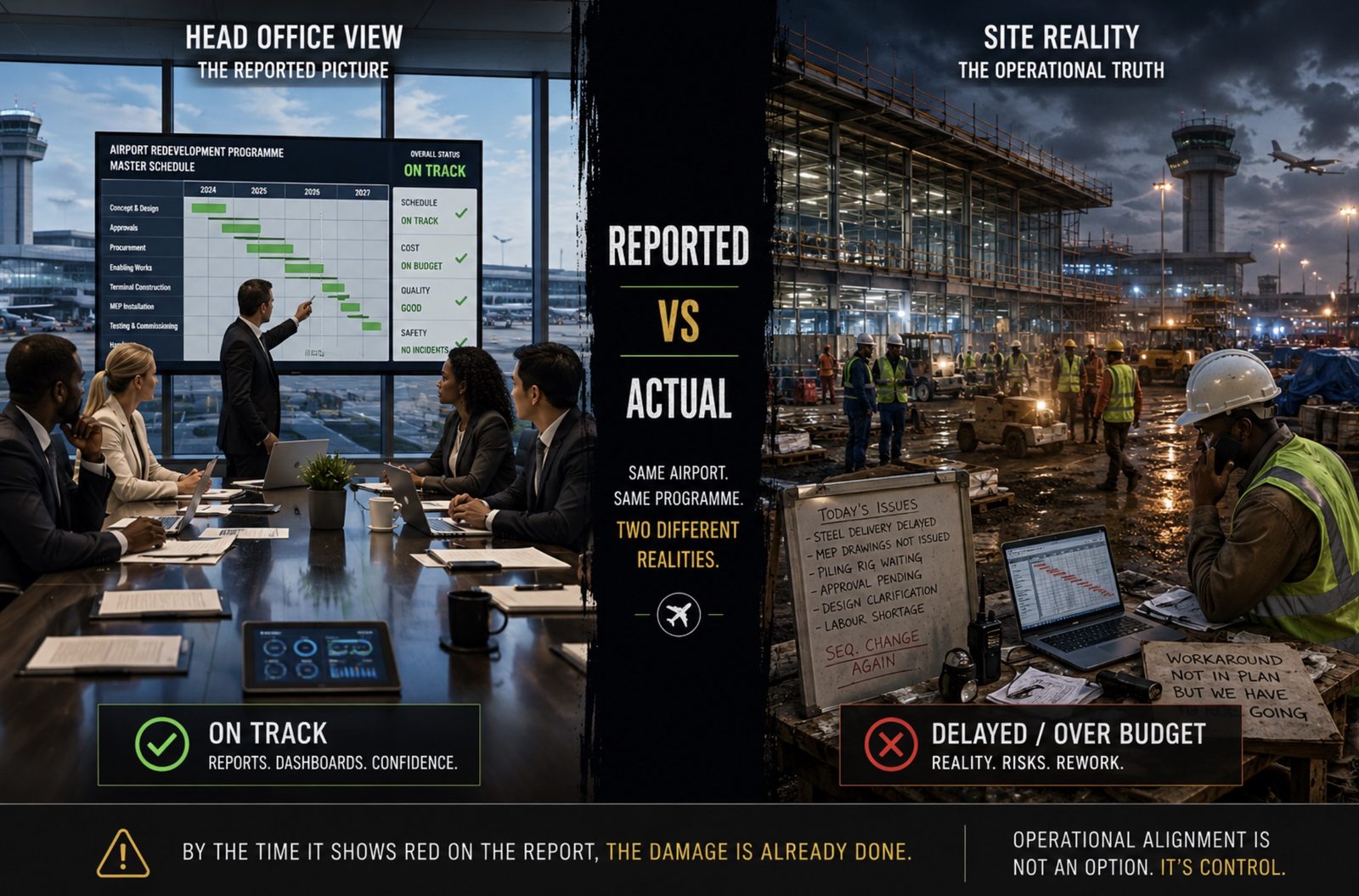
By the time a steering committee notices a delay, the operational reality on site has been drifting for weeks.
The site sequence changed.
Supplier dates slipped.
Workarounds replaced the original plan.
The dashboard stayed green.
That last line is the problem. Not a reporting failure. A control failure. Two entirely different things.
The assumption that is costing the $2.4 trillion
The prevailing belief in airport infrastructure: if the capital is there and the contracts are signed, the projects will be delivered.
The contracts are signed on almost every project that fails. The capital was committed. The governance framework was in place. The project still drifted.
What was missing was not funding or intent. It was operational control — the layer between the governance system and what actually happens on site next week.
Governance documents what was agreed. Control changes what happens on the ground. Most airport programmes have spent thirty years investing heavily in the first and almost nothing in the second.
The result: a $2.4 trillion investment programme being executed on top of delivery systems that were not built to carry it.
The pattern across four African airports
I spent three years leading airport infrastructure programmes across four countries in Africa: Kenya, Ghana, Zimbabwe, and a European airline’s outstation network.
Different contractors. Different regulators. Different funding structures. Different political environments.
Same failure pattern every time.
Arrive on site. Review the programme in the system. Walk the site with the construction supervisor.
The programme in the system and the programme on the ground had diverged. Sometimes by days. Sometimes by weeks. Never visibly, from the client’s office.
On one programme, a critical access road that was supposed to be complete before groundworks began had not been started. It was marked green in the master schedule. The contractor had quietly re-sequenced around it three weeks earlier, without updating the plan, without informing the client, and without anyone asking the right question.
By the time it surfaced in a steering meeting, six weeks of float had been consumed. The recovery cost more than the road.
On another programme — a cargo facility expansion — three supplier commitments were on the schedule as confirmed. None had been verified against actual lead times. One supplier’s structural components were still in a European port. Had been for eleven days. Nobody on the client side had checked.
The intervention in both cases was not a new consultant or a new tool.
It was operational alignment.
One plan that matched how work was actually being sequenced on site. One set of supplier commitments verified against real capacity. One weekly rhythm that produced decisions, not status updates.
The result across all four programmes: on time, controlled costs, operational continuity maintained. Across four countries simultaneously.
The delivery system was not complex. It was consistent.
Three things break airport projects before any contractor can be blamed
Work begins from a letter of intent, a heads of terms, or an early contractor engagement before the scope is written. Six weeks later, the project is not tracking progress — it is adjudicating what was ever agreed, while the programme bleeds.
The programme manager’s schedule is updated for governance meetings. The site team runs off a whiteboard, a WhatsApp group, and the construction supervisor’s memory. By week two they have diverged. Nobody at headquarters can see it because every governance signal still reads green.
A commitment is what a supplier says when asked. A verified date is confirmed against actual capacity, lead times, frozen drawings, approved handoffs, and proof of readiness. Every airport programme I have seen with a schedule problem had at least two supplier commitments that were accepted without verification.
Five shifts close these gaps — and create the operational foundation the $2.4 trillion deserves:
One written document: what is included, what is excluded, what the acceptance criteria are. When “was that in scope?” comes up — and it always does — the debate ends in sixty seconds.
Not the governance schedule and the site schedule. One. If the construction supervisor cannot use it on Monday morning, it is not the real plan.
Every issue, risk, and pending decision: one owner, one date, one consequence if not resolved. Open items without owners are future surprises with nobody accountable for them.
Capacity confirmed. Materials ordered. Lead times mapped. Handoffs approved. Proof of readiness defined. Anything else is an optimistic commitment you have agreed to inherit.
Same inputs. Same meeting. Same outputs — decisions made, actions assigned, slippage flagged. Not a status call. A control loop that catches drift in week one, not week six.
The objections I hear on airport programmes
“Airport projects are too politically complex for this.”
Political complexity is exactly why one operating truth matters more, not less. When five stakeholders — airport authority, government ministry, airline, contractor, and regulator — each have a different version of what was agreed, the complexity does not simplify the problem. It compounds it. One written scope, one plan, one cadence cuts through regardless of stakeholder count.
“We cannot supervise remotely — our team is in Europe.”
Distance is not the issue. Access is not control. Proof of progress is. Define what visible progress looks like for each milestone — a photo, a sign-off, a measurement. Once that is defined, time zones stop mattering.
“The contractors are the problem.”
Contractor slippage is almost always enabled by weak commitments from the client side. An unverified date, an unwritten scope, an open decision with no owner — these are client-side failures that make contractor drift inevitable. Fix the commitment design and most of the chasing stops.
The same principle. Every sector. Every scale.
The delivery system that worked across four African airport programmes is the same system that held on a €850M+ cross-border gas pipeline. The same system that delivered a camp in Equatorial Guinea at one-tenth the standard cost. The same system that recovered a six-month idle period on a cross-border infrastructure programme inside the original 24-month window.
Different sectors. Different continents. Different scales.
Same principle: one operating truth, controls connected to reality, trust built through delivery.
Four sectors. Thirty countries. €2B+ of capital projects.
The $2.4 trillion will not close the global airport infrastructure gap if delivery systems remain disconnected from execution reality.
Because the money is not the hard part.
Operational control is.