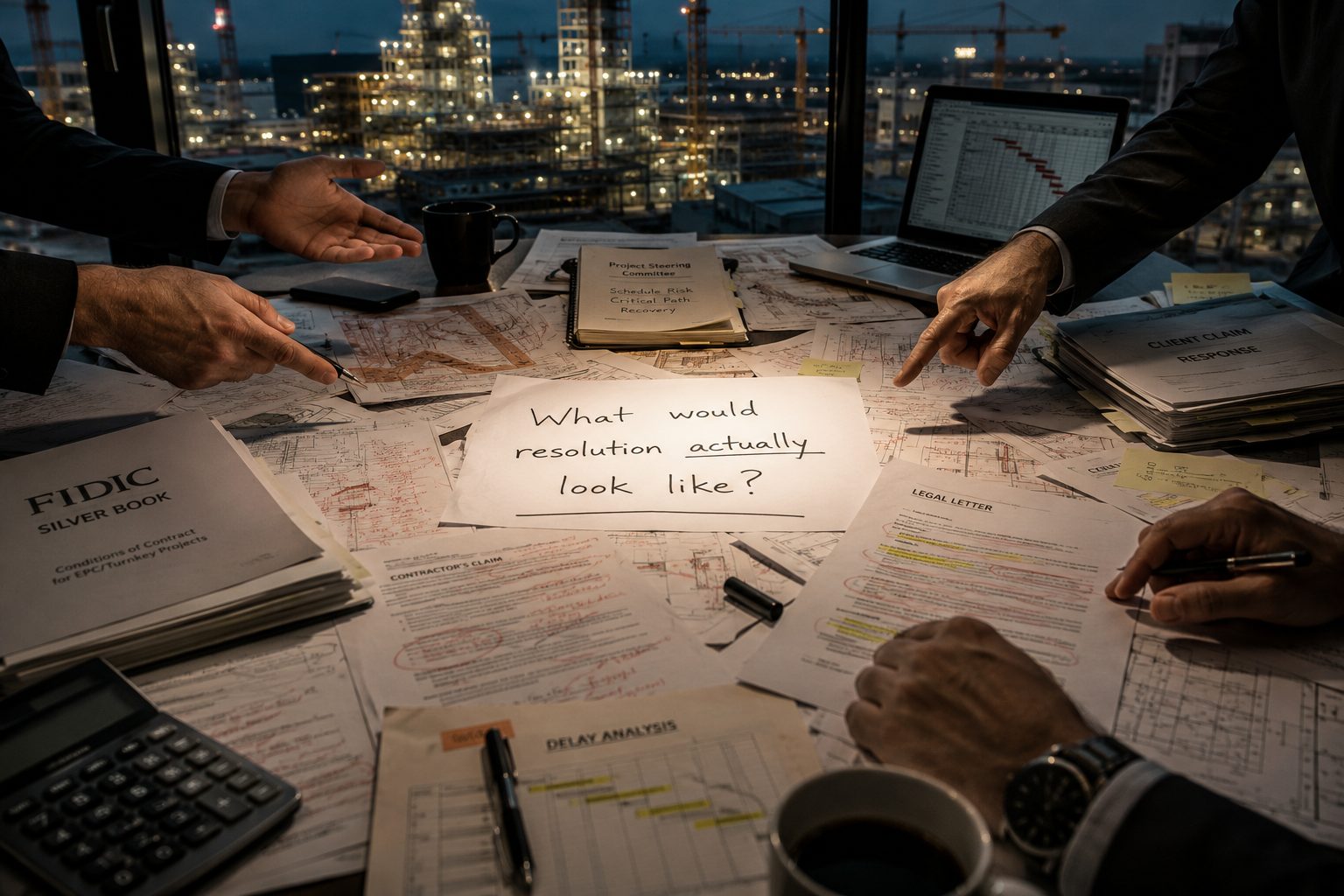
€40,000 a day.
That is what a stalled construction contract costs when both sides stop talking about the project and start talking about their positions.
A €400M energy infrastructure project in Belgium delivered under a heavily amended FIDIC Silver Book contract. Both commercial teams dug in. Legal letters crossing. The steering committee watching the schedule bleed while two sets of lawyers confirmed, separately, that their client was right. Every additional day carried a direct cost while commissioning moved further away and senior management attention remained trapped in the dispute.
“When both sides are talking about their positions instead of the project, the project has already lost.”
I was brought in not to argue the position — but to break the stall.
The assumption that keeps disputes expensive
The standard assumption when a FIDIC dispute hardens: this is a legal problem. Better arguments needed. More precedent. Stronger letters. A more senior legal team.
It is rarely true.
Most commercial stalls are not caused by a contractual gap that legal expertise can close. They are caused by two parties who have stopped talking about the project and started talking about their positions. The dispute becomes the project. The project becomes the dispute.
Legal confirms that each side is right. That is precisely the problem. Two parties, both legally correct, both commercially stuck, both watching the clock.
The contract created the positions. It could not resolve them. Something else had to.
This is the same pattern that appears across delivery governance. Documents create records. They do not create alignment. Contracts define positions. They do not create commercial consensus. In both cases, the paperwork survives while the project drifts.
When that happens, the problem is no longer contractual. It is operational.
What broke the stall
Both teams in separate rooms. The intervention was not a negotiation. It was a diagnosis.
Before anyone sat across a table, each party was asked one question — separately, without the other present:
“If this were resolved tomorrow — what would that actually look like for you?”
Not “what are your claims?” Not “what will you accept?” What would resolution look like.
The answers were different in language. They were nearly identical in substance.
The contractor needed the variation recognised — not necessarily paid in full, but acknowledged as a legitimate change event. The client needed the completion timeline protected and a clean handover without a dispute running into commissioning.
Neither of those were incompatible. They had been made to look incompatible by the positional framing both legal teams had constructed over three weeks of letters.
The overlap was the deal. It just needed to be visible to both sides at the same time.
The stall broke in two sessions. Not because anyone changed the contract. Not because one side surrendered its position. The conversation simply shifted from defending claims to protecting project outcomes.
The project completed. The relationship survived the dispute. The legal costs stopped accruing. Both sides moved forward without the shadow of an unresolved arbitration over commissioning.
That outcome was not achieved by a better legal argument. It was achieved by changing what the conversation was about.
The five steps of a Commercial Reset™
A stalled contract does not need more legal horsepower. It needs a different frame. Here is the sequence that works:
Stop putting both sides in the same room. Positional conversations harden in joint sessions — each party performs for their team, their lawyers, their management chain. Separate the conversations before attempting to reconnect them.
Ask each party: what does resolution actually look like? Not what they are claiming. Not what they will accept. What the project needs to look like in six months for this to have been resolved well. Listen for the commercial interest underneath the contractual position.
In almost every stall, the underlying interests are more compatible than the stated positions. Map them side by side. The gap between “what we need” and “what they need” is almost always smaller than the gap between the claim schedules.
Bring both parties back together around the project — not around the dispute. The agenda is not “who owes what.” The agenda is “what does a successful project outcome require from each side?” That shift changes the entire dynamic of the conversation.
Once the reframe holds, move fast. Agree the principle. Document it. Let the legal teams work out the contractual expression of what both sides have agreed commercially. That sequence is the opposite of how most disputes are managed. It works faster and at a fraction of the cost.
The objections I hear before every reset
“The other side isn’t acting in good faith.”
Usually, they are. What looks like bad faith is almost always a party protecting a position their legal team has confirmed is solid. The moment the conversation moves from positions to interests, the bad faith tends to disappear.
“We have a strong legal position. Why would we reframe?”
A strong legal position is a negotiating asset — not a reason to avoid a faster, cheaper resolution that preserves the project and the relationship. Arbitration often takes years, consumes executive attention, and permanently changes the commercial relationship.
“The contract forces us to follow the formal dispute process.”
FIDIC has a dispute process. It does not prevent commercial conversations happening in parallel. The formal process is the backstop. The reset happens in the space between the current position and arbitration — a space that both sides have every incentive to use.
The same principle — two more proof cases
On a major gas transmission programme in France, six months of commercial deadlock had already consumed significant management time and repeated escalation attempts. The same sequence was applied: separate diagnosis, interest mapping, and reframing around project value rather than contractual positions. The deadlock resolved in three sessions.
On a major gas pipeline programme operating in a complex cross-border environment, sustained contractual pressure never evolved into a full commercial breakdown because discussions remained anchored to delivery outcomes rather than positional arguments. The objective was not to win the argument. It was to keep the project moving.
“The moment both sides start talking about what the project needs instead of what the contract says, a path forward exists. It always existed. The positional framing just made it invisible.”