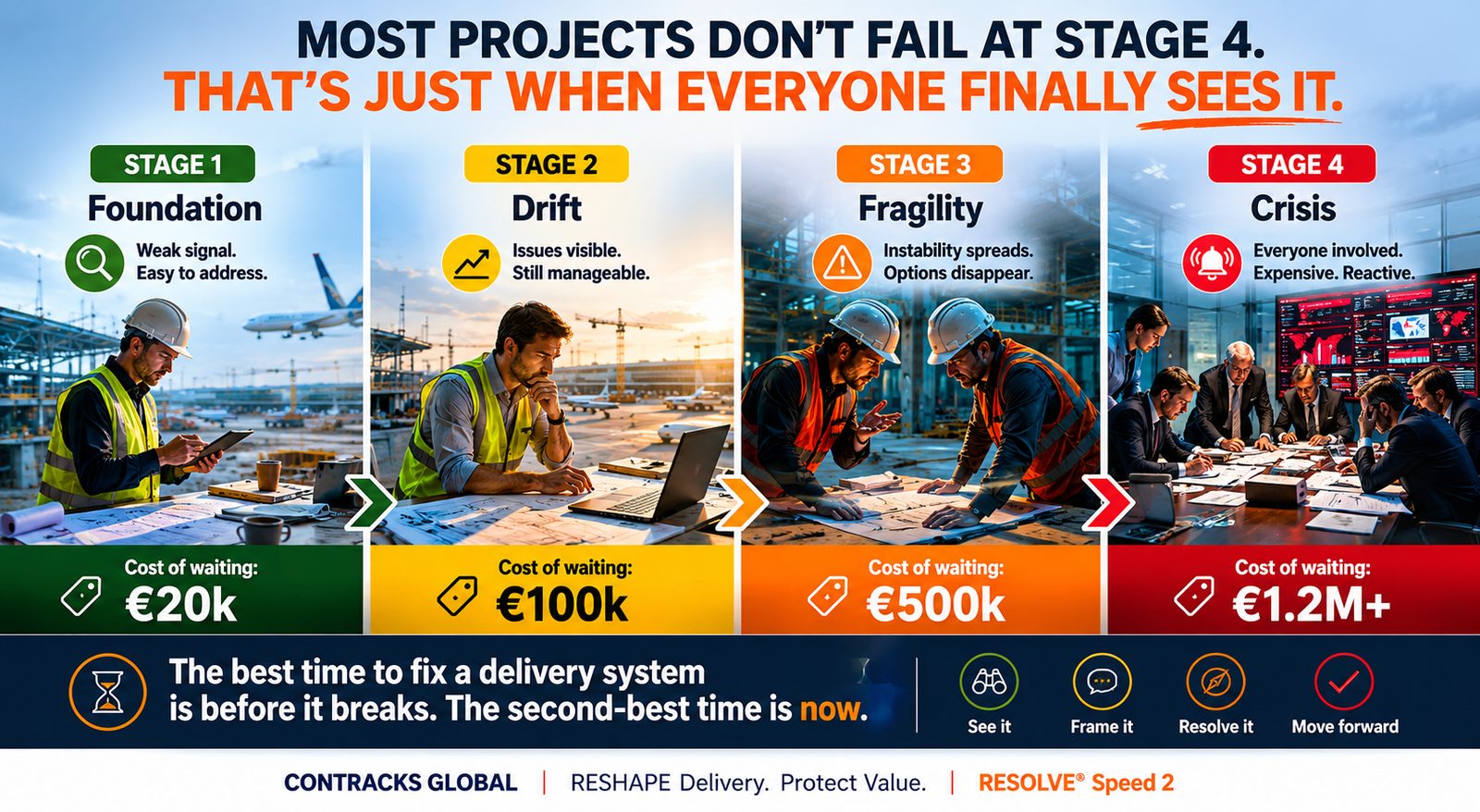
€1.2M.
That was the acceleration bill on a major cross-border infrastructure programme after three diagnostic signals went unaddressed for six weeks. Beyond the bill, senior leadership spent nine weeks firefighting rather than delivering the next programme.
The controls that would have prevented it were available in week two. At a fraction of that cost. The gap — between when the problem was visible and when it was addressed — is where the money went.
“Most people call for help at stage four. By stage four, the options are narrower, the evidence is cooler, and the cost of resolution is a multiple of what prevention would have been.”
The question is not whether you will need help. It is at which stage you ask for it.
The assumption that makes stage four inevitable
Most organisations operate on a version of the same belief:
“We will know when something is serious enough to call for outside help.”
They won’t. Not because they are not paying attention. Because the signals at stage two look manageable. A slipping vendor. A scope debate. An open decision that has been in the log for three weeks. Each one individually looks like normal project friction.
By the time the signals aggregate into something undeniable — a steering committee question that has no clean answer, a forecast revision that triggers a board conversation, a dispute that has hardened into legal correspondence — stage four has already arrived.
The cost of stage four is not just financial. It is credibility. It is relationships. It is the six months of management attention that could have been spent on the next project instead of recovering this one.
The four stages — and what each one actually costs
Every programme, every venture, every commercial relationship passes through versions of these four stages. The question is whether you recognise which one you are in.
The venture is running on momentum and relationships. No written contracts. No commercial framework. No clear scope. It works because everyone knows each other. It stops working the moment scale, a dispute, or a new party enters.
Scope control (C1) is the lever here. Without a written scope, there is no baseline to govern against.
Cost of waiting: Low now. Catastrophic at scale.
The programme is running. The governance looks right. And something is quietly wrong. Vendor dates slipping. Scope expanding without formal change. Open decisions accumulating. The cost of leaving it is growing faster than the cost of fixing it.
Schedule control (C2, C4) and decision closure (C3) are where drift shows up first. The master schedule and site reality have diverged.
Cost of waiting: Low if addressed this week. Compounding if ignored.
The business is delivering. Revenue is growing. And the operational infrastructure is not keeping pace. Three people know where everything is. When one leaves, the knowledge leaves with them.
Information control (C5) is the critical gap. Without a fixed cadence and shared operating truth, knowledge concentrates in individuals rather than systems.
Cost of waiting: Moderate now. Severe when a key person leaves.
A dispute has hardened. A steering committee has lost confidence. A missed milestone has triggered a contractual consequence. Legal is involved. The question is no longer how to prevent it — it is how to limit the damage and recover.
All five control pillars have broken down. Recovery requires rebuilding from the point of last verified truth.
Cost of waiting: Highest of all four stages. Options narrowest.
How to know which stage you are in — right now
One question for each stage:
If a new partner, investor, or client asked you today to show them the contract framework for your key commercial relationships — could you produce it in under ten minutes?
If you called your site supervisor or delivery lead right now and asked what is actually happening this week — would the answer match your master schedule? If not, you are at stage two. The window is still open.
If your most operationally critical person handed in their notice today — how long would it take the next person to be fully productive? If the answer is “months” or “we are not sure”, you are at stage three.
Is there a dispute, a stall, a missed milestone, or a governance failure that your senior leadership is already aware of? If yes, you are at stage four. The question is how quickly you move.
The two reasons people stay at stage two too long
“It is not serious enough yet to bring someone in.”
That is stage two speaking. The signal at stage two is almost never a crisis — it is friction. A vendor who keeps changing the date. A scope item that keeps coming up in meetings. An open decision that nobody wants to own. Together, they are the early warning system for stage four.
“We can handle this internally.”
Sometimes true. Often the people best placed to handle it internally are the same people currently managing the symptoms. A delivery control install does not replace your team. It gives them the system they need — faster and without the compounding cost.
The cost of stage two versus stage four — from real programmes
A major cross-border infrastructure programme: three diagnostic signals at stage two, left unaddressed for six weeks. The stage two intervention cost a fraction of a percent of the programme value. The result of waiting: €1.2M acceleration bill, nine-week delay, and nine weeks of senior leadership attention diverted from the next programme.
A large energy infrastructure project: a stage two commercial drift — a variation that should have been captured and agreed — became a stage four dispute. Three weeks of legal letters before a commercial reset broke it in two sessions. Those three weeks of legal costs exceeded the reset cost many times over — and eroded trust, pushing commissioning back by months.
“The best time to fix a delivery system is before it breaks. The second-best time is now.”
Four sectors. Thirty countries. €2B+ of capital projects. The pattern is consistent: stage two interventions cost less, recover faster, and preserve more than stage four recoveries. Every time.