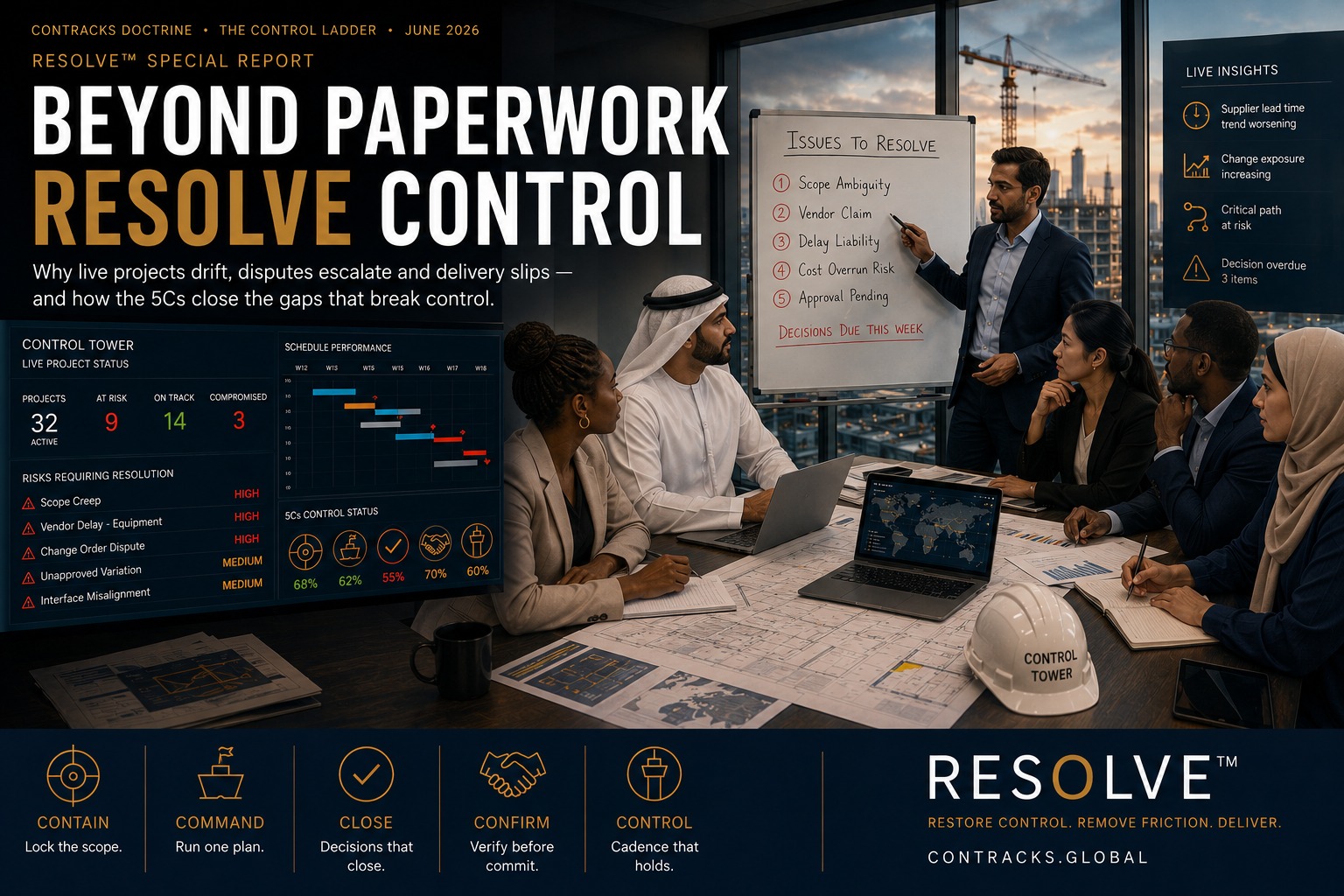
Beyond Paperwork Governance.
The PMO Control Lead’s complete guide to No-Surprises Delivery. Written and narrated by Serguei Poppeleer.
Cross-border programme delivery fails not because teams are incompetent but because the governance architecture is not enforceable. Stage gates report what happened. Nobody changes what happens next.
Scope drift that becomes rework. Open items that become delays. Vendor promises that become disputes. Forecasts revised until finance stops believing them. PMO credibility eroding one steering meeting at a time.
RESOLVE™ — built on The 5Cs Framework™: Contain the Scope, Command One Plan, Close Every Decision, Confirm Vendor Dates, Control Tower Cadence. Five enforceable mechanisms that turn governance from documentation into delivery control.
A PMO that calls problems early. Vendors held to verified commitments. Decisions that close before they become delays. A control lead who walks into every steering committee with command — not explanations.
Controls are only real if they change what happens next week. If they do not change decisions, vendor behaviour, or handoffs — they are not controls. They are artefacts.
The steering pack was green the week before the project blew up. The RAID log had 47 items. Eleven had owners. Three had deadlines. None had consequences.
If you run PMO controls on the owner side, you already know the dirty secret: most project governance looks solid in a deck and still fails on the ground. The steering pack is polished. The stage gates are defined. The RAID log is busy. Everyone can point to a template. But week after week, the same things keep happening: scope shifts after supplier quotes come back, site constraints surface late, and decisions that should take 24 hours take three weeks because nobody truly owns them. Meanwhile suppliers keep missing dates, showing up under-resourced, or delivering partials — and every call comes with a new story.
“The dashboard stayed green. The project drifted. Nobody saw the gap until the bill arrived.”
The stakes are not just schedule and cost. The real risk is exposure. Because when delivery slips in a cross-border, politically charged environment — Europe to Africa, multiple sites, multiple suppliers, multiple jurisdictions — your PMO is the surface area where the blame lands. Forecasts get revised, executives lose trust, and governance becomes a performance instead of a control architecture.
This report is written for the PMO Control Lead who is tired of being treated like the template police and wants what leadership actually wants: predictable delivery and no surprises.
The Governance Illusion
Most owner-side PMOs are running what looks like control: stage gates, RAID logs, dashboards, monthly packs, steering cadence. On paper, it is governed. In reality, the work is being decided somewhere else — in side conversations, supplier calls, site constraints, and late-stage “we didn’t realise” moments. So delivery drifts. And governance stays clean. That combination is the problem.
That is the trap: you are explaining the project instead of controlling it. And in a steering committee, nobody remembers the RAID log. They remember who looked in control. The PMO Director who had all the right reports — and none of the right answers. That is the reputation that sticks.
If you keep treating governance as proof of control, three things happen — and none of them are abstract. Your credibility takes the hit in steering committees. You end up defending process instead of showing command. Forecasts keep getting revised, and finance stops believing you. Each change feels reasonable in the moment, but over quarters it becomes a pattern: delivery is unpredictable, and your numbers cannot be trusted. Commercial leakage becomes normal. Change orders, disputed acceptance, and “that wasn’t in scope” arguments turn into real money leaving the business — and real time leaving your week.
In high-stakes, cross-functional delivery, controls are not a mirror. Controls are supposed to be a mechanism. If your governance architecture cannot force clarity, force decisions, and force alignment between the official plan and the real work, then it is not control. It is documentation.
“Controls are not a mirror. They are supposed to be a mechanism.”
| Governance Failure | Typical Impact |
|---|---|
| RAID items with no owner or deadline | Delays that were preventable become programme-critical in weeks |
| Scope accepted without written criteria | “Was that included?” becomes the weekly meeting agenda |
| Vendor dates accepted without proof of readiness | Idle crews, expediting fees, cascade delays |
| Status calls that report history | Slippage visible only when recovery is no longer cheap |
| Multiple plan versions | Enforcement impossible — nobody agrees on what was actually committed |
| No decision consequence | Open items drift for weeks; crises replace decisions |
Each of these failures is individually manageable. Together they compound. That is what governance drift looks like at velocity.
The project did not start. It splintered. Three versions of scope, three versions of the plan, and a weekly meeting that became scope court.
It feels right because everyone is under pressure to start. Stakeholders believe they roughly agree on what’s needed. Details are expected to emerge after suppliers quote, after site walks, after engineering gets deeper. Why it fails: when requirements are half-baked, the project splinters. Procurement quotes one version, ops expects another, engineering designs a third, and the supplier optimises for whatever is easiest to deliver. Then governance gets dragged into the worst kind of weekly meeting: not “are we on track?” but “was that included?” The cost is rework, re-quoting, change orders, and a PMO that has become the referee for scope arguments instead of the owner of progress.
The plan in the deck and the plan on site diverged at week two. Nobody noticed until it mattered.
It feels right because the master schedule exists, the stage gates are defined, and the report format is accepted. Leadership sees neat documents and assumes the machine is running. Why it fails: when the official plan is built for reporting, and the site reality runs on informal priorities, the two diverge fast. By week two, the team is managing two projects — the one in the deck, and the one happening on the ground. Because there is no single operating truth, the contract terms, handoffs, acceptance criteria, and responsibilities also drift out of alignment. When delivery slips, you cannot enforce. You can only argue.
Without a consequence, a deadline is a suggestion.
RAID — Risks, Assumptions, Issues, and Dependencies — is the standard log most PMOs use to track open items. In theory, it is a control tool. In practice, it is often a list of things nobody has decided yet. Open items do not stay open. They turn into delays, then redesign, then disputes. If a RAID item has no single owner, no decision-by date, and no consequence, it is not a control tool. It is a list of future surprises. The PMO Control Leads who earn trust in high-pressure steering rooms do three things differently: they force clarity early, they run one plan that matches how work actually happens, and they force decisions to close before they become delays.
The 5Cs Framework™
Every project that failed had a governance framework. Most of them had a good one. That is the problem nobody talks about.
Projects do not fail because the team is weak or because of bad luck. They fail because the governance architecture is not enforceable — scope, plan, decisions, vendor commitments, and cadence are left loose, negotiable, and unenforceable. Frontier markets do not create these problems. They reveal them faster. Fix the system before the project forces the fix through delays, rework, and blame.
Most programme controls are built to report what happened. The 5Cs Framework™ is built to prevent what should not happen. It replaces the standard governance stack with five operating mechanisms that turn clarity, decisions, and plan alignment from intentions into obligations.
| # | Pillar | Name | What It Does |
|---|---|---|---|
| C1 | CONTAIN | Contain the Scope | Fuzzy requirements → written scope with assumptions, acceptance criteria, and explicit out-of-scope items locked before work starts |
| C2 | COMMAND | Command One Plan | Deck governance → one operating plan that matches site reality week to week |
| C3 | CLOSE | Close Every Decision | RAID drift → every open item has a single owner, a decision-by date, and a stated consequence |
| C4 | CONFIRM | Confirm Vendor Dates | Optimistic promises → capacity, lead times, handoff dependencies, and proof of readiness verified |
| C5 | CONTROL | Control Tower Cadence | Status updates → fixed weekly rhythm, same inputs, same outputs, slippage caught before it compounds |
Fuzzy requirements become a written scope with assumptions, acceptance criteria, and explicit out-of-scope items locked before work starts. This is not a document exercise. It is the commercial mechanism that removes the most common excuse for rework, change orders, and disputes.
Deck governance becomes one operating plan that matches site reality week to week. A single version of truth that site, procurement, engineering, and suppliers all recognise — not a parallel deck that diverges from the ground by week two. The PMO had the right report. The wrong project.
RAID drift becomes a controlled output. Every open item has a single owner, a decision-by date, and a stated consequence if it stays open. “I’ll align offline” stops being an acceptable output of any meeting.
“Without a consequence, a deadline is a suggestion.”
Optimistic promises become verified commitments. Dates are only accepted when tied to capacity, lead times, handoff dependencies, and proof of readiness. The vendor cannot hide behind “we were waiting on you” when readiness is defined upfront. The supplier confirmed they were on track. They were not. Nobody had checked.
Status updates become a fixed weekly rhythm — same inputs, same meeting, same outputs, every time. Slippage is caught early. Corrections happen while there is still room to move. The PMO becomes a control tower, not a reporting function.
“The PMO that surfaces problems at the steering committee is firefighting. The PMO that surfaces them eight days earlier is controlling.”
This is not PMO tooling. It is not project controls compliance. It is Distributed Delivery Governance — the operating architecture that makes execution hold when stakeholders are in different countries, the work is remote, and the standard playbook breaks down.
Proof from the Field
Remote camp build in Equatorial Guinea. Standard assumptions: frontier market, no supply chain, limited local capability. Delivered in 28 months against a 36-month standard. At roughly one-tenth of the typical cost. Zero claims filed. Payment released by the state client on a single note: “We have started the works.”
- Decision cycles compressed from 6–8 weeks (formal letter exchanges) to a matter of days (direct phone calls)
- PM team relocated from Malabo — a full day’s travel from the project — to direct on-ground contact in Oyala, adjacent to the site
- The relationship and trust built through that physical presence were the operating conditions that made delivery hold
- No fence required — the local community built it; no claims filed; zero disputes at completion
What held: scope was clear before mobilisation, the plan was shared, decisions were forced, vendor commitments were verified. When controls match reality, delivery becomes predictable — even in environments where most projects drift.
Major cross-border pipeline programme. Multiple jurisdictions, hostile contracting environment, complex multi-party interfaces. The 5Cs Framework™: scope locked through supplier quote cycles. One operating plan recognised by all parties. Decision log with owners and deadlines enforced through the commercial framework. Vendor commitments verified against capacity and lead times before acceptance. Weekly control tower cadence with evidence-based reporting replacing story-based updates.
- Programme certainty held under pressure. Claims exposure of €30M+ documented and maintained in real time
- Zero disputes surfaced at completion. Commercial leakage contained. Delivery held
2017: Saudi army at the border. Ports empty. All GCC goods — aluminium, glass, steel fixings, construction materials — blocked in Dubai or cancelled with penalties. Not a force majeure event per the contract. The contractor’s estimate at the time: a one-year project stall and a 30% overrun on the overall programme budget. The intervention: new suppliers identified and qualified in Turkey and Asia within weeks. Design adapted to available materials without reopening scope. Contracts closed cleanly. Everything shipped through non-GCC routes without disturbing the project rhythm.
- Zero claims filed despite full regional embargo conditions
- Zero cost increase — slight saving against budget
- Metro line opened on time and on budget; contractor’s estimated 30% overrun avoided entirely
Two governance challenges. One 10-year programme. Both resolved without litigation, without delay, without budget impact. Challenge 1: a major land collapse created €25M+ exposure. The resolution used the programme’s own architecture — a three-phase, 10-year structure that allowed costs to be apportioned across phases, the timeline adjusted, and the investor framework restructured. No single party absorbed an impossible cost. Challenge 2: 5,000 land certificates, one airstrip, communities that could not be approached conventionally. The resolution was not legal. It was relational. Village chiefs engaged as the real decision-makers.
- €25M+ exposure resolved through programme restructuring — no single party absorbed an impossible cost
- Zero litigation across both cases — for 10 years
- Both projects started on time. No budget impact on either
PMO Control Maturity — Where Does Your Function Sit?
| Level | Operating Reality | What This Looks Like in Practice |
|---|---|---|
| Level 1 | Template Compliance | Stage gates exist. RAID log exists. Nothing closes. Site runs on informal priorities. |
| Level 2 | Reporting Without Control | Governance looks polished in the deck. The real plan lives in a WhatsApp thread. |
| Level 3 | Multi-Version Confusion | PMO has one version of progress. Site has another. Finance has a third. Nobody reconciles. |
| Level 4 | Verified Governance Cadence | One plan. Decisions closing with owners and deadlines. Vendors held to verified dates. |
| Level 5 | Control Tower PMO | Framework operating. Slippage caught early. Steering committee gets command, not explanations. |
Five Shifts That Change Everything
If you are serious about no-surprises delivery — controls that match reality — do this next.
Locking scope is not paperwork — it is removing the most common excuse for late work, rework, and finger-pointing. When scope is written in one place — assumptions, acceptance criteria, and what is explicitly out of scope — “was that included?” disappears. The PMO stops adjudicating surprises and starts owning progress.
A RAID and a RAG can describe a mess without changing it. Running one real plan means the site, procurement, engineering, and suppliers all reference the same operating truth. When delivery slips, you can enforce, not just argue.
“I’ll pick it up in the next steering” is not a decision. It is a delay with a meeting attached. Forcing decisions to close means RAID items stop being a list of future surprises and start being a control mechanism.
Supplier optimism is not a schedule. Confirming vendor dates means verifying against actual capacity, actual lead times, actual handoff dependencies — before accepting the commitment. When dates are verified, they hold. When they slip, you see it early enough to recover.
Reactive meetings are a symptom of a system that surfaces problems too late. A fixed control tower cadence catches slippage when it is still recoverable. All parties — site, procurement, engineering, suppliers, owner — exchange together, not sequentially.
The Questions You’re Probably Asking
Even when you can see what’s broken, it is still normal to hesitate. As Head of PMO, you are accountable for outcomes but you do not control every function, site, or supplier. So if part of you thinks “we already have stage gates” or “this is too political,” that is not resistance. It is pattern recognition from projects where governance looked solid on paper but reality did not move with it.
“We already have stage gates and templates — this is what we do.”
You already have the standard kit. But templates do not create control — operating truth does. If the official plan and the real plan diverge by week two, stage gates become a paperwork exercise. Your pain shows up in the weekly steering meeting: debating scope instead of tracking progress, late commissioning surprises, constant reforecasting.
“This is too political — I cannot force decisions across functions and borders.”
You are not trying to win politics — you are trying to shorten the time decisions stay open. The leverage is not authority, it is decision design: clear owner, decision-by date, required inputs, and a consequence if it stays open. When you install a fixed cadence with explicit decision rights, you create a repeatable path to closure that holds even when stakeholders are in different countries.
“We cannot get real control because the work is happening on sites we cannot see.”
Access is not the same as control. You do not need to be on site to run the work — you need a definition of proof. What counts as done this week, what evidence must exist, and what the next handoff depends on. Most remote programmes fail because reporting is story-based instead of proof-based.
“Vendors are the problem — we cannot control them.”
Vendor slippage is usually enabled by weak commitments, not bad intentions. If dates are accepted without proof of readiness — drawings frozen, materials ordered, approvals done, handoffs defined — the vendor can always claim “we were waiting on you.” When commitments are rebuilt around capacity, lead times, and acceptance criteria, you get fewer surprises because the supplier is measured on controllable leading indicators, not optimistic promises.
The Core Truth
A PMO Control Lead is not there to police templates. They are there to make delivery hold — especially when reality pushes back. Your value is not more documents. Your value is control that survives contact with the field.
Ready to Make This Real?
If this report felt uncomfortably familiar, do not start by rebuilding templates or adding more governance. Start by getting a clean diagnosis of where control is actually breaking down.
A free diagnostic. 10 minutes. It tells you whether your main exposure is scope drift, governance that doesn’t match the field, or vendor slippage — and gives you a written report you can share with your Project Director, Ops, and Procurement.
30 minutes. We pressure-test one live project and identify the 1–2 control moves that will stabilise delivery fast using The 5Cs Framework™. If we are not a fit, you still walk away with a specific next step you can run internally. No obligation.
Serguei Poppeleer is the Founder and Managing Director of Contracks Global. He has managed projects across 30+ countries for clients including ENI, EnergiNet / Baltic Pipe, ArcelorMittal, a major European airline, Doha Metro, Intels Nigeria, and a major Belgian energy provider.
Executive MBA, Hult · LLM Oil & Gas, Robert Gordon University · M.Sc. Civil Engineering, Polytechnic of Mons
Controls are only real if they change what happens next week.
The CONTROL diagnostic maps your governance exposure across the 5Cs and tells you which one to fix first. Free, instant, no commitment.
Take the CONTROL diagnostic → Book a Reality Check →